
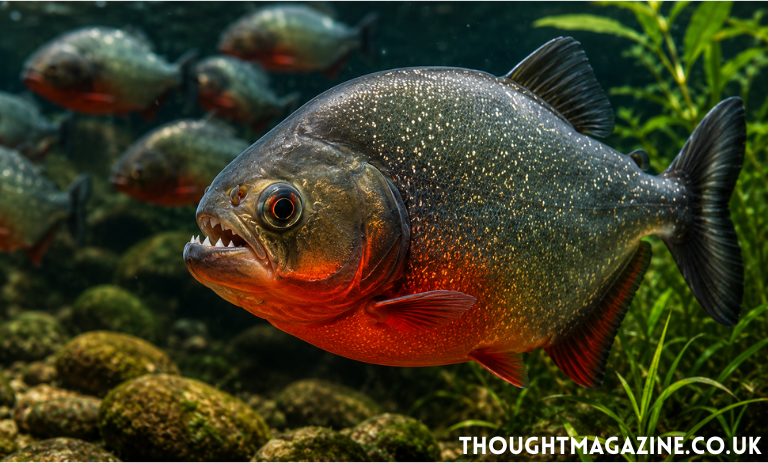
Piragnia is a word that can cause confusion because it looks and sounds very similar to “piranha.” Someone encountering it for the first time may assume that it is the official name of a fish, a separate species, or perhaps a lesser-known relative of the piranha. In most contexts, however, piragnia appears to be an alternative spelling, phonetic variation, or mistaken form of the familiar word piranha rather than the recognized name of a distinct fish.
This distinction matters when looking for reliable information. Piranhas are real freshwater fish with established scientific classifications, known habitats, feeding patterns, and physical characteristics. Piragnia does not have the same established position in zoological classification. Understanding why the two words become mixed together helps separate an unusual search term from the actual biology of the fish people generally have in mind.
What Does Piragnia Mean?
There is no widely recognized fish species formally called piragnia in standard zoological naming. The word is generally encountered in situations where the intended subject appears to be the piranha. It may result from spelling a word according to how it sounds, remembering the name incorrectly, or encountering a nonstandard version elsewhere.
This type of variation is common with animal names that have moved between languages. People hear a name in conversation, films, television programs, games, or online videos and later reproduce it according to pronunciation rather than its established spelling. Piragnia therefore makes more sense as a language variation connected with piranha than as the name of an independent animal.
Why Piragnia Is Often Confused With Piranha
The similarity between the two terms is the main reason for the confusion. Both have almost the same sound and are frequently associated with descriptions of freshwater fish with sharp teeth. When piragnia appears in informal material, the surrounding information often concerns South American rivers, predatory fish, feeding behavior, or piranha attacks.
For practical purposes, people researching piragnia are usually looking for information about piranhas. The important difference is that “piranha” is the established common name used in biological and general reference material. Using the recognized term also makes it easier to identify individual species instead of treating every piranha as the same animal.
Piranhas Are a Group, Not One Fish Species
One common misunderstanding surrounding piragnia and piranhas is the idea that the name describes a single species. Piranhas actually belong to a broader group of South American freshwater fishes. Different species vary in appearance, size, habitat preferences, diet, and behavior.
Genera commonly associated with piranhas include Pygocentrus and Serrasalmus. The red-bellied piranha is among the best-known examples, largely because it is frequently shown in documentaries, aquariums, and popular entertainment. Other species may look less familiar but share physical features associated with the broader piranha group.
Where Piranhas Live
The fish commonly associated with the word piragnia are native to freshwater environments in South America. They occur in major river systems and connected aquatic habitats across parts of the continent. The Amazon basin is particularly famous for piranhas, although their natural distribution is not limited to one river.
Depending on the species, they can occupy rivers, streams, floodplains, lakes, and other freshwater areas. Seasonal changes can alter these habitats considerably. Rising water can open large flooded areas where fish spread out and find new feeding grounds, while falling water may concentrate fish into smaller spaces. Such environmental changes can affect feeding opportunities and interactions between different species.
What Does a Piranha Look Like?
Piranhas are often recognized by their deep, compressed bodies and strong jaws. Their teeth receive the most attention. Rather than having long, thin teeth like some predatory fish, piranhas generally have sharp teeth designed to cut effectively. Their jaw structure allows them to remove pieces of food with a quick bite.
Appearance differs between species and can also change as a fish matures. Some display silver or darker body tones, while others have noticeable coloring around the belly or fins. Size also varies. This diversity is another reason it is misleading to imagine piragnia or piranha as one animal with a single fixed appearance.
The Famous Piranha Teeth
Much of the piranha’s reputation comes from its teeth. They are sharp and arranged in a way that supports an efficient cutting action. Combined with strong jaw muscles, this gives the fish an effective method for feeding on suitable animal material.
Having powerful teeth, however, does not mean that a fish spends its entire life attacking large animals. Teeth are feeding tools. Their shape tells us something about how an animal can process food, but it does not by itself establish how aggressive that animal will be in every situation. Piranha behavior depends on species, food availability, environmental conditions, and perceived threats.
What Piragnia or Piranhas Actually Eat
Popular culture tends to present piranhas as dedicated meat eaters that immediately attack anything entering the water. Their actual diets are more complicated. Depending on species and circumstances, piranhas may consume fish, insects, crustaceans, pieces of animal tissue, seeds, fruits, and other available material.
Scavenging can also be part of their feeding behavior. A dead or injured animal in the water offers food without requiring the fish to overpower healthy prey. This opportunistic approach is common in nature because animals generally benefit from using food sources that are readily available.
Are All Piranhas Carnivores?
Describing every piranha simply as a strict carnivore gives an incomplete picture. Different members of the broader group can have different dietary habits, and even a single species may change what it eats depending on season and availability. Animal matter may form an important part of the diet for some species, while plant material can also be consumed.
This flexibility is useful in changing river environments. Food sources do not remain equally available throughout the year. A fish capable of using several types of food has more options when normal prey becomes scarce. Diet should therefore be understood as part of a changing ecosystem rather than as a fixed rule.
Why Piranhas Swim in Groups
Piranhas are frequently shown moving in groups, and this has contributed to their frightening image. A large number of sharp-toothed fish swimming together can easily be interpreted as a coordinated hunting unit. Grouping, however, can serve several purposes.
One important reason is protection. Piranhas are predators in some situations, but they can also become prey for larger aquatic and land animals. Staying near other fish may reduce the risk faced by an individual. Groups can also help fish respond to food sources and environmental changes. The presence of a school should not automatically be interpreted as evidence that an attack is about to occur.
Do Piranhas Hunt Together?
Some feeding situations can bring many piranhas to the same food source, producing the fast and chaotic activity associated with them. This does not necessarily mean they operate like highly coordinated pack hunters. Multiple fish may simply be competing for an available meal.
When food is limited, competition can become intense. A large carcass or injured fish may attract numerous individuals, and each animal attempts to obtain food before it disappears. Seen from above the water, this can resemble an organized group attack even when individual feeding competition is driving much of the activity.
Are Piranhas Really Dangerous to Humans?
Piranhas are capable of biting people, and their teeth can cause injury. That fact should not be replaced with the opposite myth that they are harmless. At the same time, their ability to bite does not support the movie-style image of humans routinely being consumed within moments after entering South American rivers.
Human interactions depend heavily on circumstances. Low water levels, restricted habitat, food scarcity, disturbance, or activity near feeding or breeding areas may influence fish behavior. People living around piranha habitats have long interacted with the same waterways for fishing, transport, and daily activities. The real risk is better understood through local conditions than through dramatic fictional scenes.
How Movies Shaped the Piragnia Image
Entertainment has played a major role in creating the modern image of the piranha. Films and fictional stories often turn animals into simple threats because an instantly recognizable danger works well on screen. A school of fish stripping prey rapidly creates a memorable scene, even if it does not represent normal behavior.
Repeated portrayals eventually become part of popular knowledge. Someone who has never seen a piranha outside a movie may assume that the fictional version accurately describes the animal. This helps explain why unusual spellings such as piragnia can also circulate: much of the public’s familiarity with the subject comes from informal culture rather than biological terminology.
Piranhas Have Predators Too
The image of an unstoppable predator overlooks an important ecological fact: piranhas are part of a food web. Larger fish, aquatic predators, birds, and other animals can prey on them. Humans also catch piranhas in regions where they naturally occur.
This changes the way schooling behavior can be interpreted. A group of piranhas is not necessarily gathering because it wants to hunt something larger. Individuals may benefit from remaining in a group because they themselves face danger. Like many animals, piranhas can occupy different positions in the food chain depending on their age, size, location, and surrounding species.
Their Role in Freshwater Ecosystems
Piranhas contribute to the functioning of South American freshwater ecosystems in several ways. Predatory species can influence populations of smaller fish and other aquatic organisms. Scavenging behavior may help consume dead animal material, while species that eat seeds or plant matter participate differently in the movement of nutrients through aquatic environments.
No animal operates independently of its habitat. Changes in piranha populations can affect prey, competitors, and predators. Likewise, changes to river systems, water quality, seasonal flooding, or available food can influence piranha populations. Looking at these ecological relationships gives a more accurate picture than concentrating only on their teeth.
Piranhas and Seasonal Water Conditions
South American river systems can undergo major seasonal changes. During periods of flooding, water spreads across large areas and creates additional habitat. Fish may gain access to new food sources and become more widely dispersed. As water levels fall, animals can become concentrated in smaller pools and river channels.
These conditions can affect how piranhas behave. Greater competition for food and space can occur when fish become crowded. Reports of aggressive feeding behavior therefore need environmental context. What happens during a stressful dry period should not automatically be treated as the normal behavior of the species throughout the year.
Piranhas in Home Aquariums
Interest in the piragnia or piranha name sometimes comes from aquarium enthusiasts. Their distinctive appearance and reputation make certain species attractive to experienced fish keepers. However, piranhas are not ordinary community aquarium fish and should not be purchased simply because their reputation seems interesting.
Keeping them requires knowledge of adult size, tank capacity, water quality, feeding requirements, compatibility, and safe maintenance. Regulations can also differ by location, and some places restrict the ownership or movement of particular fish. Anyone considering keeping piranhas should check applicable local rules and understand the needs of the exact species rather than relying on general assumptions.
Why Correct Identification Matters
Calling a fish piragnia may seem like a minor spelling issue, but correct identification becomes important when discussing biology. Closely related fish can behave differently, reach different sizes, and require different conditions. Information about one species should not automatically be applied to another.
Scientific and established common names provide a more reliable way to identify an animal. If a website, seller, video, or social media post describes something as a piragnia, checking the species name can reveal what fish is actually being discussed. This is especially useful for aquarium care, wildlife education, and discussions about natural distribution.
Piragnia as a Search and Language Variation
The continued appearance of piragnia demonstrates how language changes outside formal scientific settings. People frequently create alternative spellings based on pronunciation. Once those versions appear online, search engines, forums, comments, and copied text can allow them to spread further.
That does not make every alternative spelling scientifically meaningful. In this case, piragnia is best approached as a term associated with piranha rather than evidence of a separate recognized animal group. Readers searching for piragnia will generally find more accurate biological information by looking for established piranha species and their scientific classifications.
Common Misunderstandings About Piragnia
The first misunderstanding is that piragnia must be a separate fish because the spelling is different. There is little reason to treat the term that way without a specific scientific species name attached to it. A spelling variation alone does not create a new biological category.
The second misunderstanding concerns behavior. Whether someone calls the fish piragnia or piranha, it should not automatically be described as an animal that constantly searches for humans or large mammals to attack. Piranhas are freshwater fish responding to food, predators, competition, reproduction, and changing environmental conditions.
What Makes Piranhas Interesting Beyond Their Reputation?
Piranhas are worth studying precisely because their real lives are more complicated than their public image. Their jaw structure shows how fish can become adapted to particular feeding strategies, while their schooling demonstrates the balance between being a predator and avoiding predators.
Their varied diets also challenge the assumption that sharp teeth automatically indicate a completely meat-based lifestyle. Combined with seasonal changes in South American waterways, these characteristics make piranhas useful examples of how animal behavior develops in response to habitat and food availability.
Final Thoughts on Piragnia
Piragnia is best understood as an unusual spelling or informal variation associated with the word piranha rather than the established name of a separate fish species. When the term appears in discussions about sharp-toothed freshwater fish from South America, piranhas are usually the animals being described.
The real fish are more complex than their reputation suggests. Piranhas possess effective teeth and jaws, can display intense feeding behavior, and are capable of causing bites. They also eat varied foods, face predators of their own, respond to seasonal environmental changes, and play normal roles within freshwater ecosystems. Separating the term piragnia from fictional ideas about piranhas makes it easier to understand both the language behind the name and the biology of the animals it is commonly intended to describe.